
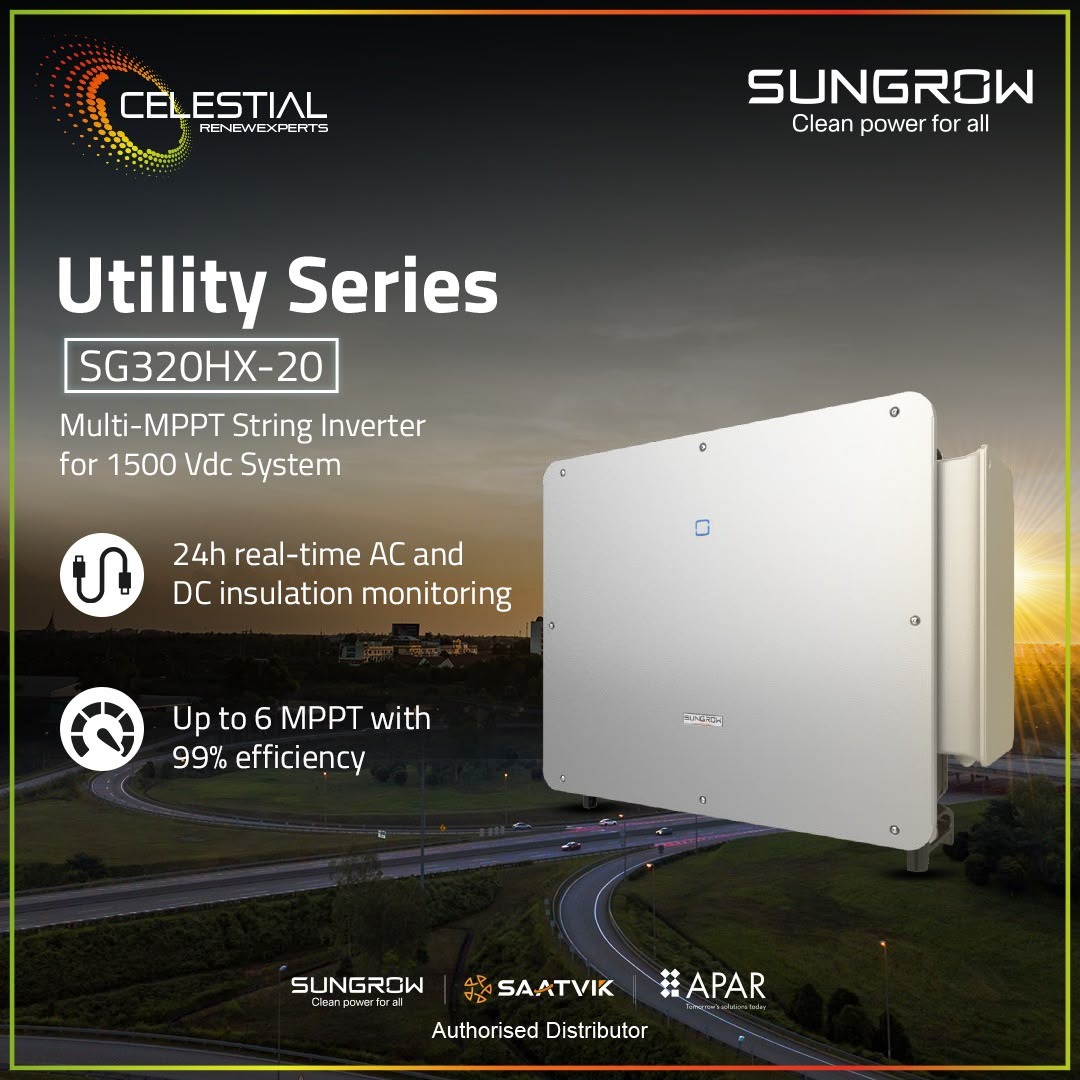
Utility-Scale Solar Is Booming — Here's Why the Sungrow SG320HX-20 Is Becoming the Inverter Benchmark
Quick answer: The Sungrow SG320HX-20 is a 320 kW, 1500 Vdc multi-MPPT string inverter built for utility-scale and large C&I solar plants. It combines up to 99.02% maximum efficiency, up to 12 independent MPPT trackers, intelligent string-level fault diagnostics, and a -30°C to +60°C operating range — making it one of the most deployed utility inverter platforms in India's fast-growing solar market. It is distributed by Celestial Renewexperts LLP in @Location , a Sungrow channel partner since 2017 with 2.5+ GW of solar products supplied.
If you're an EPC contractor, IPP, or industrial buyer evaluating utility inverters in 2026, this guide breaks down where the market is headed and why the SG320HX-20 keeps showing up as the default spec on large ground-mount and C&I projects.
India's Utility Solar Market in 2026: The Numbers Behind the Boom
India's solar sector is in the middle of its steepest growth curve yet, and utility-scale projects remain the single biggest driver of that expansion.
- India's cumulative installed solar capacity crossed roughly 150 GW by March 2026, with MNRE reporting cumulative physical progress of over 162 GW by May 2026.
- Utility-scale solar alone added close to 19 GW of new capacity in the first half of 2026 — around 32% higher than the same period in 2025.
- FY2026 (April 2025–March 2026) saw close to 35 GW of new ground-mounted (utility-scale) solar capacity added, more than double the previous year's pace, largely driven by projects under MNRE's large annual bidding programs.
- Analysts project India's solar market will keep expanding at a strong double-digit CAGR through 2031, with utility-scale projects continuing to account for the large majority of total solar capacity additions.
- On the inverter supply side, Sungrow remains the single largest inverter supplier to India's utility solar market, shipping over 10 GW in Q1 2026 alone — more than any other single OEM in the country.
The takeaway for developers and EPCs: project pipelines are large, timelines are tight, and downtime is expensive. In this environment, the inverter — the single most electronics-heavy, failure-prone component in a solar plant — has become a make-or-break procurement decision.