
A 585Wp module changes the DC side of a solar plant, but it does not determine the transformer size by itself. You will be able to verify DCR eligibility, calculate the correct module count, test string and inverter compatibility, and judge whether the design gains outweigh its mechanical and procurement constraints.
Key takeaways
- Treat DCR as an origin requirement, not proof of module performance.
- Recalculate module count, string voltage and DC capacity before changing panel wattage.
- Check inverter current limits, MPPT voltage range and transformer export capacity.
- Compare energy yield, compliance risk, transport and replacement effort before approval.
How to verify DCR eligibility before a tender or subsidy claim
1. Treat DCR as a procurement condition, not a performance claim. Domestic Content Requirement confirms the required domestic origin of the cells and modules; it does not prove higher efficiency, longer service life or better transformer performance. Check the tender and scheme wording before accepting a quotation for DCR modules.
2. Retain an evidence pack for both procurement and delivery. It should contain:
- The exact module model number and complete serial-number list
- The manufacturer’s signed DCR declaration
- Purchase invoices and delivery challans
- Cell- and module-manufacturing evidence required by the scheme
- The applicable MNRE procurement-framework status for that model
- Inspection, dispatch and delivery records linking the supplied serial numbers to the approved model
ALMM is a separate check: it confirms that the applicable model and manufacturer appear on the approved list. DCR confirms domestic content. IEC 61215 design qualification and IEC 61730 safety qualification support module quality and safety, but neither certification proves DCR eligibility.
3. For dcr solar panels in pune, verify the tender’s exact DCR wording, current MNRE rules, ALMM applicability, local-discom interconnection requirements and sanctioned export capacity. Pune is not a separate DCR category.
A manufacturer’s ALMM listing alone cannot support a subsidy claim if the scheme also requires domestic cells, and a DCR declaration cannot replace the project’s electrical approvals.
How 585Wp modules change DC sizing without changing transformer capacity
For a target DC capacity, divide watts by 585 and round up: 1,000,000 ÷ 585 = 1,709.4, so a 1MWp array needs 1,710 modules. A 540Wp design needs 1,852 modules, reducing the count by roughly 7.7%.
Fewer modules can reduce mounting hardware, module connections, string-combiner inputs, cable routes and installation labour. Check the module dimensions, weight, mounting holes, clamp zones, mechanical loads, tracker geometry, roof walkways and lifting plan first; a larger panel can invalidate existing layouts.
Use this checklist before approving the DC design:
- Confirm that fewer modules actually reduce strings and collection circuits, rather than increasing current per input.
- Treat module watts as DC capacity, not transformer kVA. A 1.2MWp array feeding a 1.0MWac inverter block is coordinated with AC output, power factor, overload duty, ambient derating, harmonics, auxiliary loads and the permitted export limit.
- Verify the transformer’s low-voltage winding voltage, short-circuit withstand, neutral arrangement, protection settings and medium-voltage interconnection.
- Separate solar panels and transformers in maintenance planning: panels need inspection for cracks, hotspots, soiling, connectors and insulation faults; transformers need checks for oil or temperature alarms, bushings, insulation, winding condition, protection trips and cooling.
- Remember that the answer to saatvik dcr 585wp solar panels benefits transformers is indirect: fewer DC collection circuits, not automatic transformer downsizing. The transformer still follows the inverter and grid connection study.
Which string and inverter checks determine whether 585Wp modules fit
A 585Wp rating does not prove that a module fits an inverter. For 585Wp solar panels for EPC projects, record these datasheet values before fixing the string layout.
| Datasheet item | EPC check | Consequence if missed |
|---|---|---|
| Maximum-power voltage and current | Compare with MPPT voltage and current limits | Clipping or unstable tracking |
| Open-circuit voltage and short-circuit current | Calculate extremes and protection duty | Overvoltage or nuisance trips |
| Maximum series-fuse rating and maximum system voltage | Size fuses and confirm plant voltage class | Module damage or insulation failure |
| Connector rating and temperature coefficients | Match connectors, cables and thermal calculations | Hot joints or incorrect voltage estimates |
Calculate cold-weather string Voc as module Voc at reference temperature multiplied by the temperature correction for the site’s lowest design temperature and the number of series modules. Keep the result below the inverter’s maximum DC voltage. Calculate hot-weather operating voltage in the same way and keep it inside the inverter MPPT window.
Compare each string’s operating and short-circuit current with the inverter MPPT limits, string fuses, DC isolators, connectors and cable ampacity. Higher-power modules can reduce string count, but their higher current increases the duty at each input.
Compatibility with the Sungrow SG150CX, SG125CX-P2, SG110CX, SG75CX-P2, SG50CX-P2, SG33CX-P2 and SG15RT-P2 cannot be confirmed from the 585Wp nameplate alone because the module datasheet values are missing. Document the final series count, parallel strings, input allocation, protection ratings and cable sizes.
What bifacial, dual-glass and N-TOPCon claims mean in actual site conditions
Bifacial gain is a rear-side irradiance assumption in the energy model, not a generic efficiency uplift. Model albedo, row spacing, module height, shading, rear-side soiling and mismatch; otherwise the forecast can overstate delivered energy.
| Surface | Expected rear-side opportunity | What to model |
|---|---|---|
| Concrete roof | Moderate, if clean and unobstructed | Roof albedo, parapets and row spacing |
| Reflective metal roof | Potentially higher, but uneven | Metal reflectance, gaps and heat |
| Ground-mounted array | Depends on clearance and spacing | Soil albedo, height and inter-row shade |
| Dark or vegetated ground | Lower rear irradiance | Soil, mulch, grass and seasonal changes |
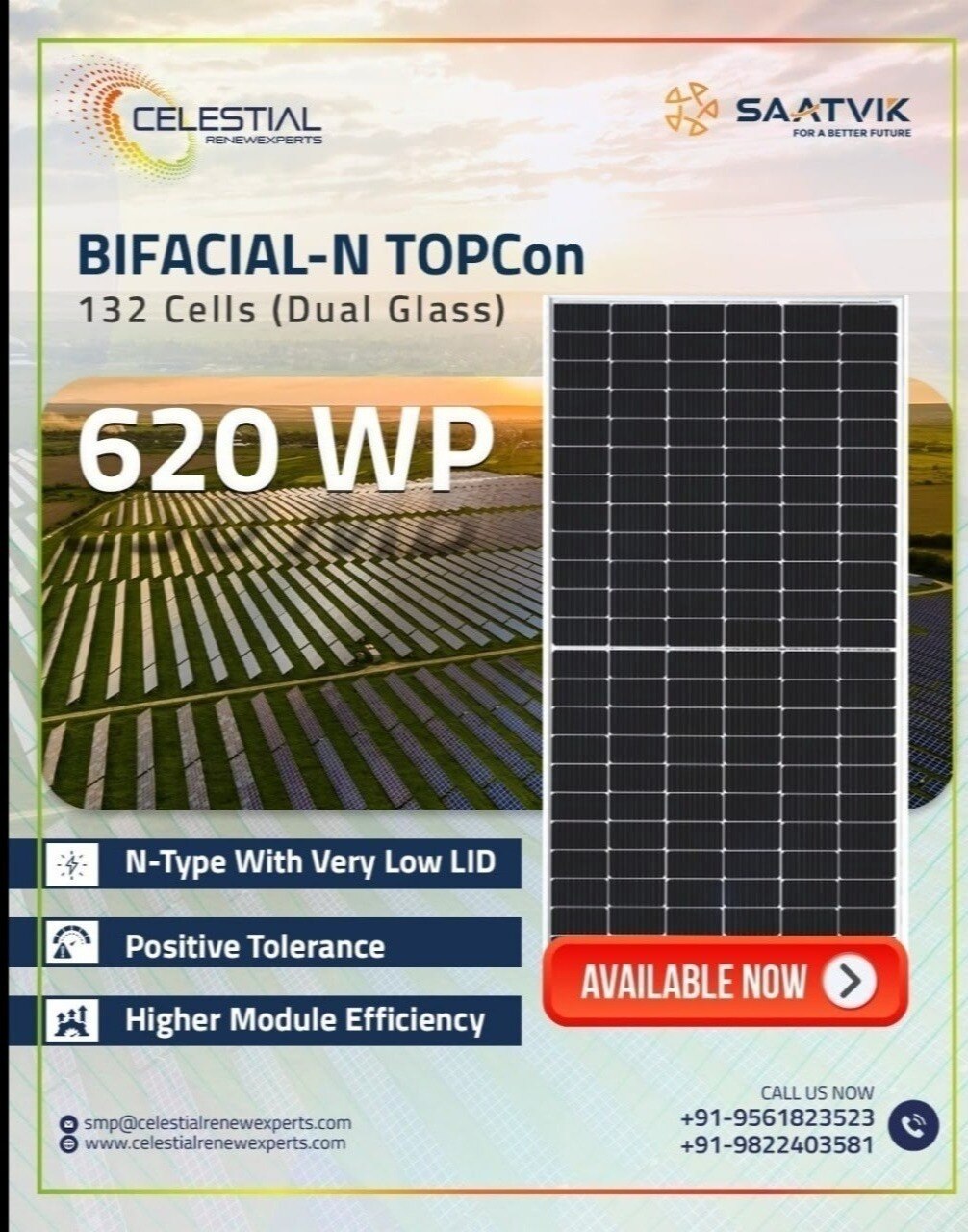
Dual glass has practical value at humid, dusty, high-temperature or chemically exposed transformer-connected sites because it resists moisture ingress and backsheets vulnerable to degradation. The trade-off is higher module weight, careful lifting, compatible rails, specified clamp zones and greater breakage risk during handling.
N-TOPCon earns a premium only when evidence beats PERC or another baseline on lower degradation, temperature coefficients, low-light response and lifetime yield. Ask for:
- The module datasheet and temperature coefficients
- Product and degradation warranties
- Independent test evidence under relevant conditions
The useful Saatvik DCR 585Wp benefits depend on delivered lifetime energy and site conditions, not the technology label alone. Assign no numerical uplift until those documents support it, including rear-side assumptions and the site’s actual shading, soiling and mismatch losses.
How to compare the project value before approving the module choice
Approve the module only after comparing delivered cost per watt and lifetime energy cost, not the invoice price. Calculate delivered cost as module price plus freight, unloading, lifting, mounting-system changes, DC cable and combiner savings, spare-module stock, and any DCR premium, divided by installed DC watts.
Divide total lifecycle cost by warranted lifetime energy after applying degradation assumptions.
| Cost item | Include in comparison | Why it changes the decision |
|---|---|---|
| Delivered installation cost | Freight, unloading, lifting, mounting changes, cable and combiner work | A cheaper module can cost more to install |
| Lifetime energy cost | Degradation, warranty terms, expected yield and replacement availability | Lower purchase cost does not guarantee cheaper electricity |
| Compliance value | DCR premium, tender wording and subsidy eligibility | DCR matters commercially only when the route requires it |
The strongest saatvik dcr 585wp benefits appear on land-constrained sites, long cable routes, high-labour projects and designs where module-count-based balance-of-system costs dominate. At 1 MWp, about 1,710 modules replace roughly 1,852 540Wp modules, reducing hardware, connections and labour.
The value weakens when fixed inverter MPPT windows, tracker row geometry, roof loading, restricted lifting access, transformer export limits or fixed interconnection capacity control the design. Confirm current, voltage, mounting fit and handling before counting the reduction as a saving.
For 585wp solar panels for epc projects, keep ALMM status, DCR evidence, inverter compatibility and transformer studies as separate approvals. Celestial Renewexperts LLP in Pune can support procurement reviews across solar generation, storage, distribution and power-quality equipment, but the EPC must perform and sign off its own calculations.
Related product
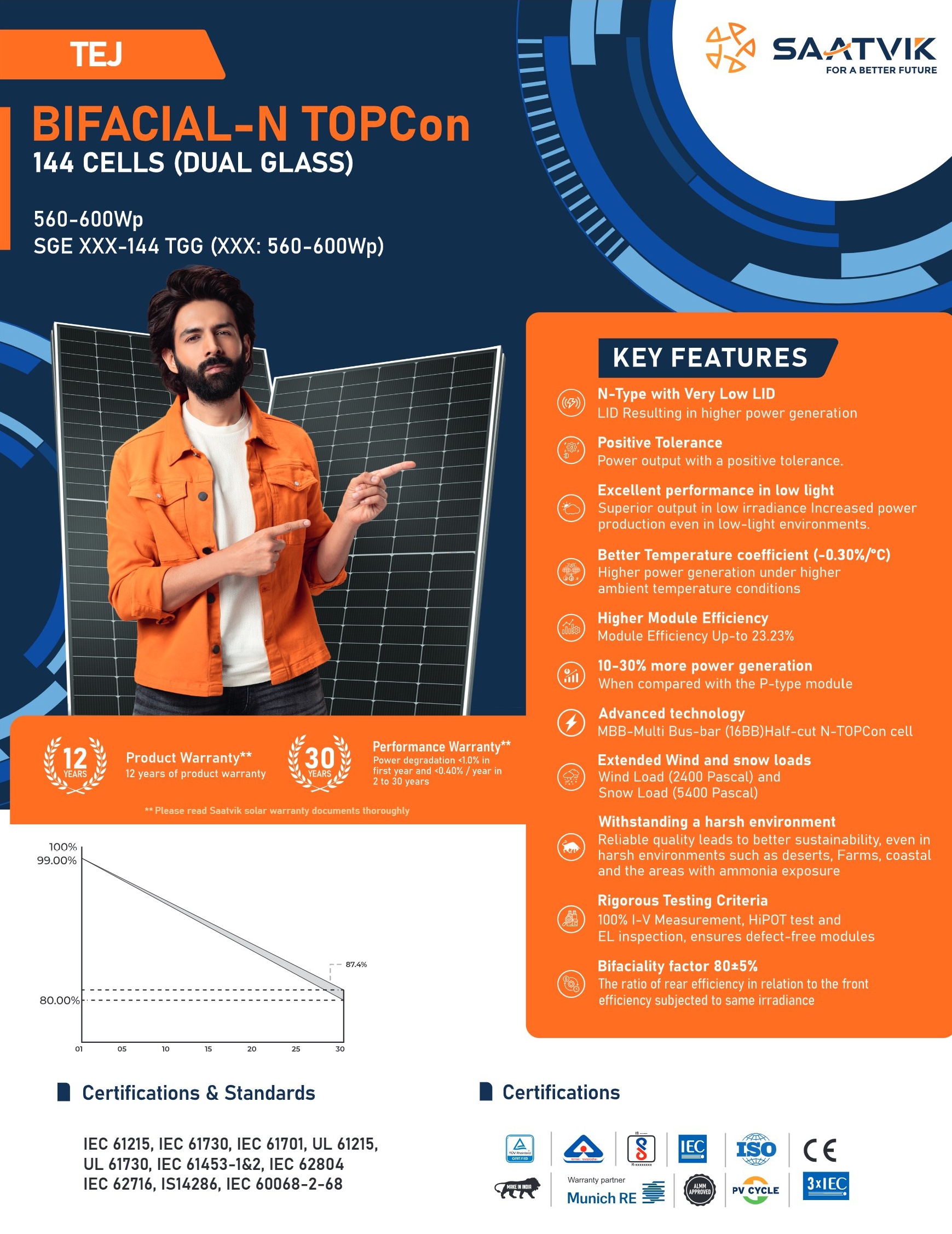 | Solar Panel Saatvik TEJ Bifacial N-TOPCon Solar Panel (144 Cells, Dual Glass) | 560W–600W Looking for a high-efficiency bifacial solar panel for your rooftop or... View product → |
Frequently asked questions
How do you verify DCR eligibility before a tender or subsidy claim?
Match the tender or scheme wording to the module documents, then request evidence of domestic cell and module origin, including the manufacturer’s DCR listing or approval record, invoice, model number and batch details. Do not treat efficiency, bifaciality or the DCR label alone as proof of eligibility.
How do 585Wp modules change DC sizing without changing transformer capacity?
A 585Wp module increases the DC nameplate for each installed panel, but it does not increase the transformer’s AC export rating. Recalculate module count, total DC capacity, DC-to-AC ratio, inverter loading and expected clipping while keeping transformer kVA, voltage and protection limits unchanged.
Which string and inverter checks determine whether 585Wp modules fit?
Compare the module’s open-circuit voltage, maximum-power voltage, short-circuit current and maximum-power current with the inverter’s MPPT voltage range, maximum input voltage and maximum input current. Check the coldest site temperature, hottest operating condition, series-module count and parallel-string limits before approval.
What do bifacial, dual-glass and N-TOPCon claims mean on site?
Bifacial output depends on rear irradiance, mounting height, ground reflectance, row spacing and shading. Dual-glass construction affects weight, handling and mounting requirements. N-TOPCon describes the cell technology, but actual yield still depends on temperature, soiling, degradation, installation and operating conditions.